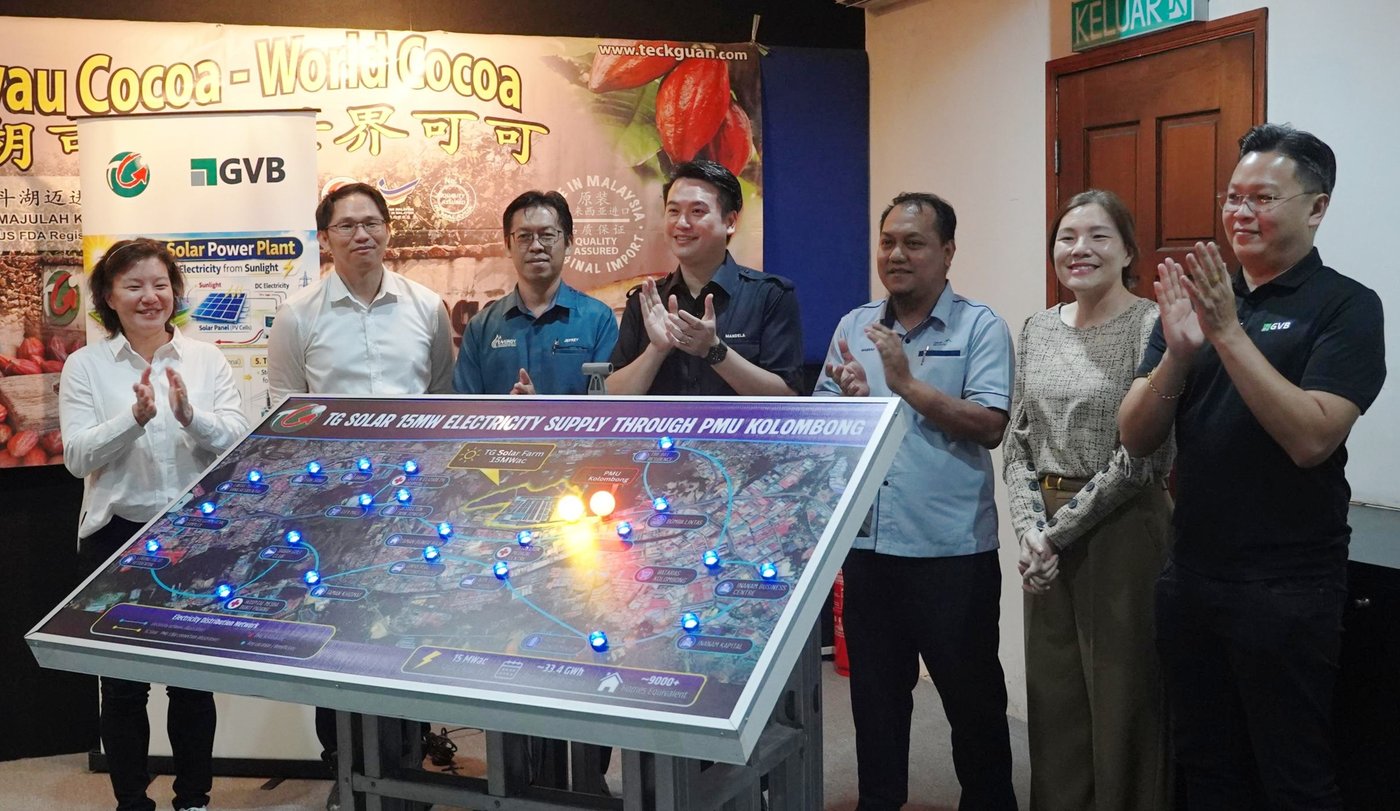
On 17 October 2026 a 15 MW solar farm at Kolombong, on the edge of Kota Kinabalu, started selling power into the SESB grid. The Energy Commission of Sabah (ECoS) says it's the first project to go all the way from bidding to commercial operation under the LSS-Sabah 2024 programme, and that it finished 40 days ahead of schedule. Sabah Chief Minister Hajiji Noor visited on 19 November and used it to push solar across the state, including in rural areas.
What's actually there. The developer is TG Solar Sdn Bhd, part of the Teck Guan Group, with GV Borneo Sdn Bhd as the main contractor. ECoS figures, reported by TV Sabah and the Daily Express in October, put it at 22.5 MWp of panels feeding out a maximum 15 MW AC, about 30,000 bifacial modules on a 36.1 acre site off Jalan Lintas, ground mounted plus rooftop. It connects at 33 kV to the Kolombong main distribution substation under a 25 year power purchase agreement with SESB. Several outlets reported the start date and the same specs, so the plant's existence and early finish check out.
The number that keeps moving. In January, at the project launch, the Daily Express reported about 26 GWh a year, enough for more than 7,000 homes. ECoS's October statement said 33.4 GWh and more than 9,000 homes. Then on 19 November the Jesselton Times reported the Chief Minister's visit with about 37 GWh a year, still for more than 9,000 homes. None of the reports explain the changes. For a sense of scale, 33.4 GWh from 22.5 MWp works out to roughly 1,480 kWh per kWp of panel each year, which is in the range you'd expect for a sunny tropical site with modern bifacial panels. The 37 GWh figure would need noticeably more than that. We'd treat 33.4 GWh, the regulator's own number, as the one to go by until real output is published.
What hasn't been tested yet. The plant has been running for about five weeks, so there's no full year of metered output to check any of those figures against. Hajiji said solar has to come with battery storage, grid upgrades and other generation, and put Sabah's renewable share at about 17 percent now, heading for about 30 percent by 2030 and 50 percent of capacity by 2035 under the state's SE-RAMP 2040 roadmap. Those are the state government's figures and we didn't find an independent tally to set beside them. Kolombong itself has no battery attached in any of the reports we read.
Verdict. Verified: the plant is built, connected and selling power to SESB, and it did beat its schedule. The yearly output is still an estimate, and three versions of it are in circulation, so watch for ECoS or SESB publishing real generation figures after the first year.