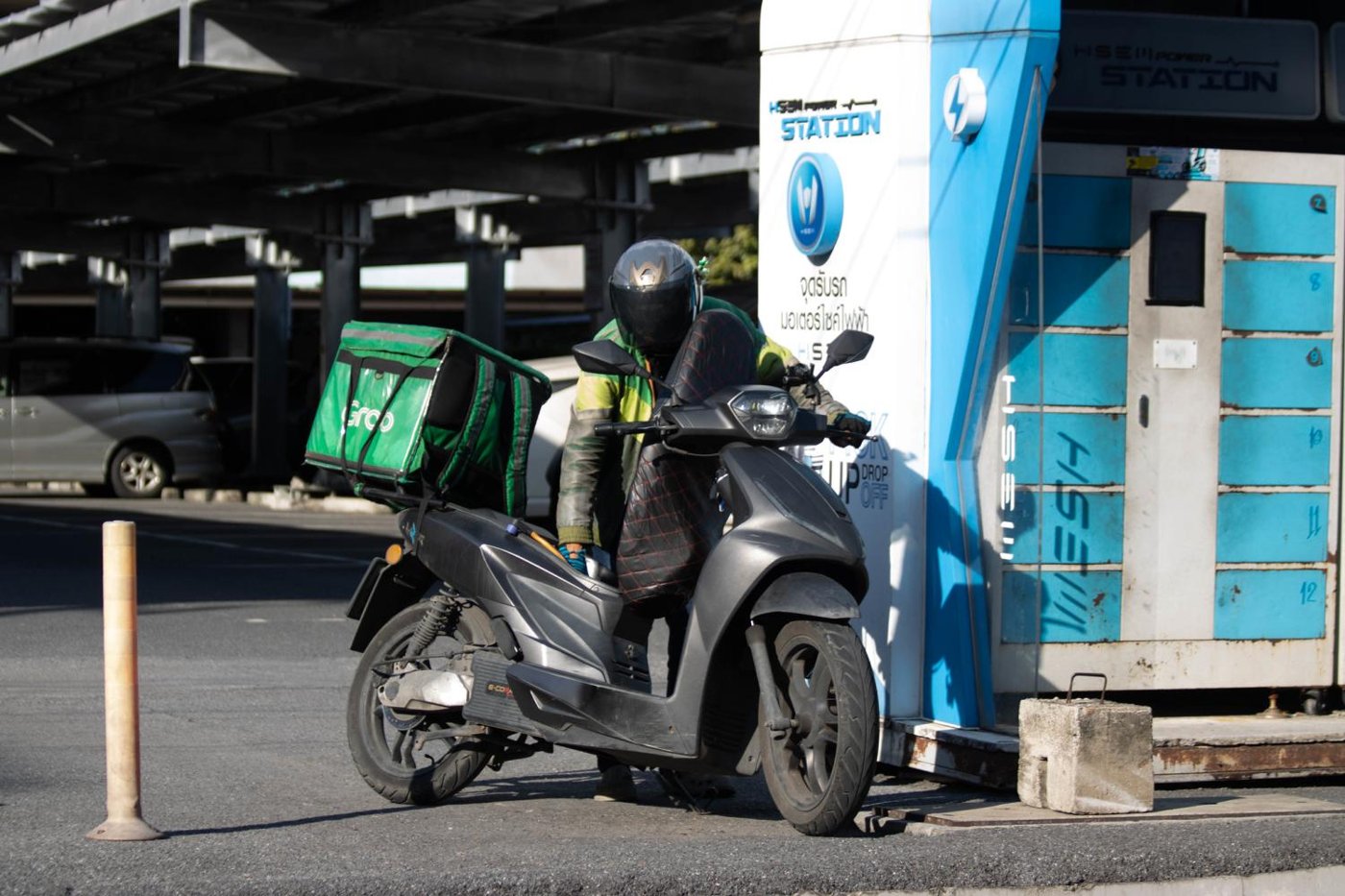
Bangkok wants its motorbike taxis, the win riders who run people from the train and the bus stop down the side streets, to go electric. There are a lot of them: figures given to the Bangkok Metropolitan Council early this year count about 5,488 authorised stands and more than 61,000 approved motorbikes. In February City Hall and Germany's development agency GIZ launched a pilot that rents riders an electric bike for ฿75 to ฿140 a day, with charging and battery swapping included.
The savings part checks out. The Thai-German energy programme TGC-EMC puts the energy cost at about ฿0.125 a kilometre for an electric motorbike against ฿1.1 for petrol. In an April 2025 focus group, all 26 electric motorbike taxi riders said their daily costs had fallen, most spending ฿21 to ฿40 a day on power. An earlier ENTEC and EGAT pilot ran 50 electric bikes in Bang Kruai and Bang Phlat for 759,354 km and cut emissions by 38.8 tonnes of CO2 equivalent.
What nobody has shown yet. Prachatai English's report on 19 November points out that the published pilot results don't show what happened to riders' take-home income, how fast the batteries wore out, or how long a rider who bought his own bike takes to get his money back. Those are the numbers a rider actually needs.
The battery problem. Samart Dornburan has run motorbike taxis for more than 30 years and heads the Bang Kruai Samakkhi stand in Nonthaburi. He switched during a pilot with a shared swap station, then the project ended and the station and spare batteries went with it. Now he carries four batteries a day at 40 to 50 km each. He paid ฿115,000 for a bike and battery and waited two months on a warranty claim when a circuit breaker failed. He has since learned to build his own packs for about ฿13,000, against about ฿25,000 for a new one. A swap operator at Sam Yan shut down after deciding the business didn't pay: taxi riders only need batteries in the morning and evening rush, not all day like food delivery riders.
Riders aren't sold. A 2026 ISSIE survey of 400 motorbike taxi riders across Bangkok's 50 districts found 49.8% didn't want to switch yet, mostly because they doubted the bikes' performance, then because of batteries. The national EV 3.5 scheme gives ฿10,000 off each locally made electric motorbike that meets its rules. So, does it work? Cheaper per kilometre, yes. A proven living for the rider, not yet, while the battery bill and the swap network sit on his shoulders.