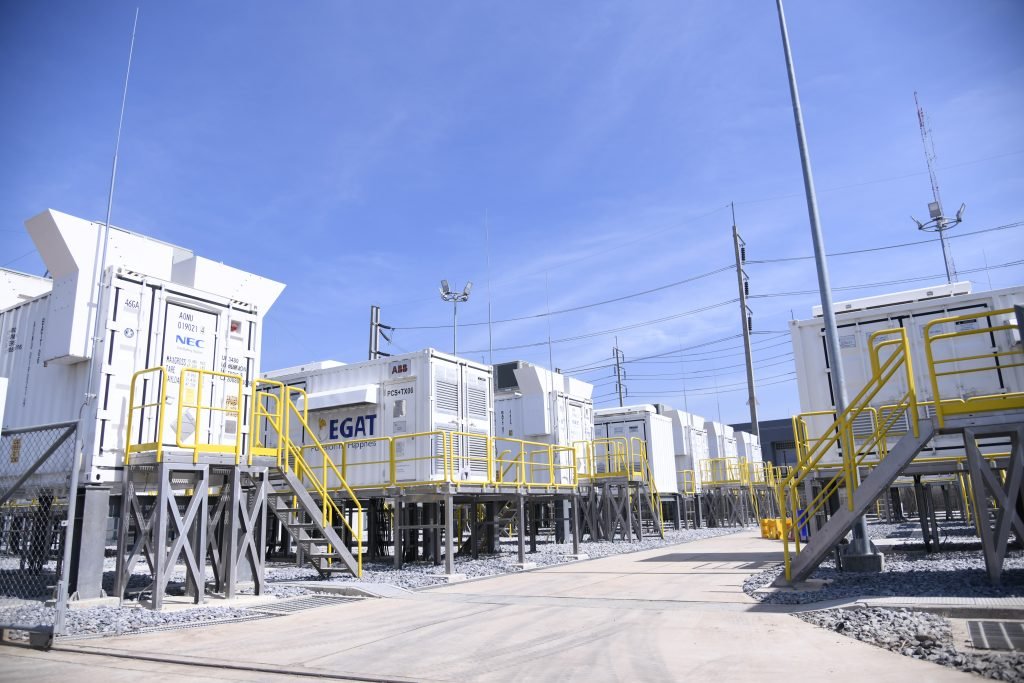
In September 2026 EGAT governor Narint Phaowanich told The Nation that the state power utility's two grid batteries, 16 MW and 21 MW, add up to 37 MW, and that about 200 MW more is planned by the end of 2027. EGAT's own website lists them: the Bamnet Narong substation in Chaiyaphum at 16 MW and 16 MWh, and the Chai Badan substation in Lop Buri at 21 MW and 21 MWh. There's also a 5 MW, 6 MWh battery working with solar in a smart grid project in Mae Hong Son.
The target. The draft power development plan from 2024 aims for 10,485 MW and 26,010 MWh of battery storage by 2037, as Energy-Storage.news reported. Do the sum: 37 MW is about a third of one per cent of that. Add the planned 200 MW and it's still under 3%. A new plan, PDP 2026, is being drafted and The Nation reports it leans on utility-scale batteries too, so the target may move.
Why batteries matter here. EGAT says its batteries sit in areas with a lot of solar and wind, to smooth out the ups and downs, and that they respond faster than anything else it has. It also says they're expensive, so they have to be sited carefully and paired with other storage. The big one Thailand already has is pumped hydro: EGAT runs Srinagarind (360 MW), Bhumibol (171 MW) and Lamtakong Jolabha Vadhana (1,000 MW), and is developing another at Chulabhorn Dam in Chaiyaphum.
Does it work? The two pilot batteries are real and connected, and EGAT describes what they do. What it hasn't published is how often they run or how much they've saved. Meanwhile demand keeps climbing, with data centres in the east a big part of it. EGAT says it'll upgrade transmission there in 2027.
Verdict. Verified: the figures line up across EGAT and the reporting. The honest headline is how far there is to go, and EGAT isn't hiding that either.